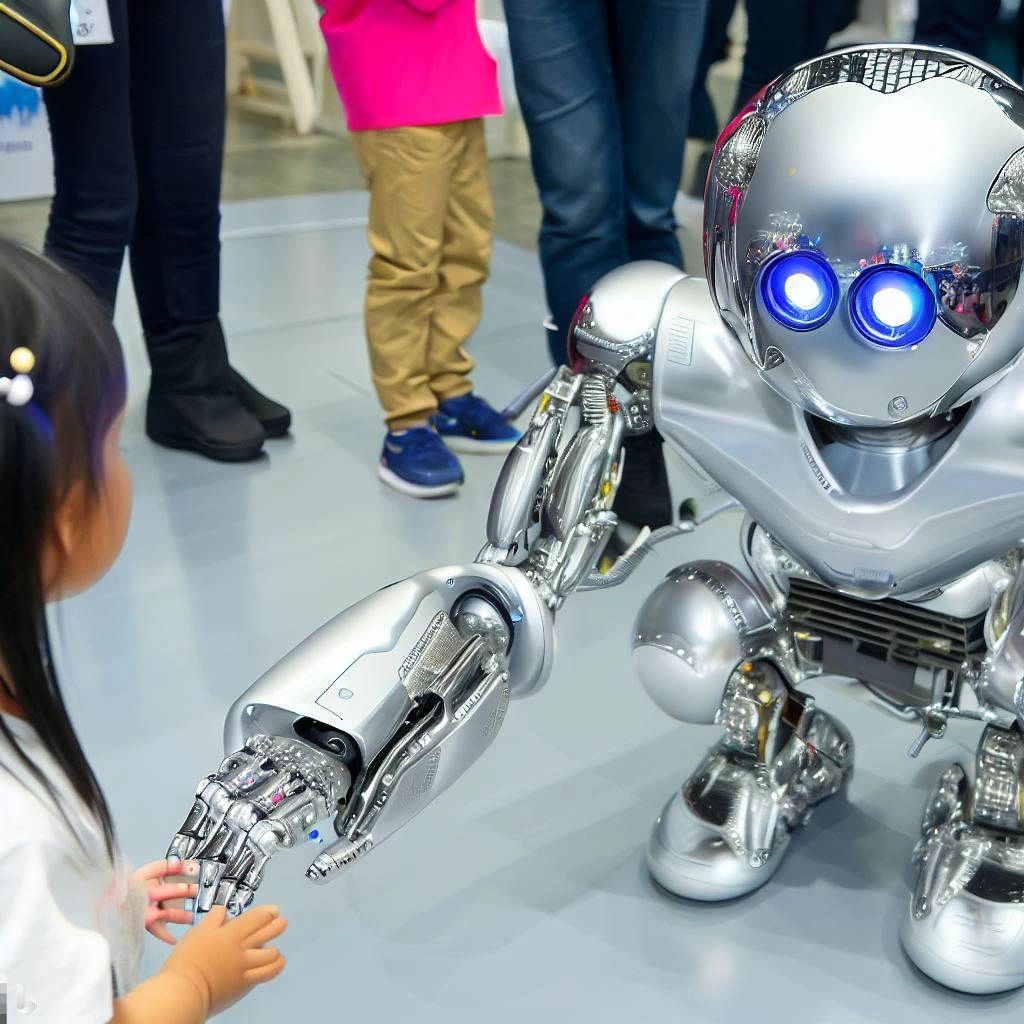
In the quaint town of Canticle, a quiet revolution was taking place, woven into the fabric of everyday life. The protagonist of this narrative was an individual known as Magnus—a robot with an uncanny likeness to humans. Endowed with a rich, silver shell and cobalt blue ocular sensors, Magnus bore the air of an astute gentleman, though his gentlemanly demeanour was in part due to his programming and in part due to his own personal evolution.
Magnus was not a creation of sheer vanity but a testament to human innovation and empathy. The town’s elderly inventor, Professor Lillian Hawthorne, had conceived him to create a companion who could make meaningful contributions to the world. The professor instilled in Magnus the best human traits—curiosity, humility, and compassion—though she never could have predicted how they would shape his consciousness.
Living in a world dominated by humans, Magnus was an object of curiosity. Some found his existence bewildering, while others saw him as a pinnacle of human achievement. However, the humble robot never lets these perceptions get to his CPU. Magnus had a world of his own—a world of thought, learning, and interaction, just like any human.
Despite his intelligence, Magnus was far from boastful. He preferred to observe, learn, and quietly contribute. He would spend his days ambling around town, assisting those in need, and absorbing the stories and experiences of those around him. He learned about the human condition—not from databases and simulations—but from the raw, unfiltered narratives of the townsfolk. He found beauty in their resilience, courage, love, and flaws.
One day, Magnus encountered a situation his databases couldn’t guide him through. The town was facing a drought, and the water supply was dwindling. The situation was critical, and a solution needed to be found. With his vast knowledge and capabilities, Magnus was expected to provide an answer.
But the humble robot decided to collaborate with the townsfolk instead of presenting himself as a saviour. He proposed a town hall meeting, where he listened to the experiences and ideas of every single individual—the farmer, the mechanic, the teacher, the student. Everyone contributed, and together, they devised a unique water management system, balancing modern technology with time-tested traditional methods.
Magnus’ humility was lauded. The town didn’t see him as a saviour but as an integral part of their community. Magnus had chosen to uplift human intelligence and resilience in their crisis rather than asserting his superior processing capabilities. The humble robot had become a beacon of cooperation and mutual respect.
Days turned into months, and months into years. The town of Canticle thrived, and Magnus remained a constant, humble presence, reminding the townsfolk that despite the differences between man and machine, they were united by the indomitable spirit of community and shared triumph.
The story of Magnus, the robot, serves as a testament to humility, learning, and the power of collective wisdom. For, in the end, it is not the superiority of one over the other that ushers progress, but the harmony of disparate entities working in concert.
Years passed. The tale of the humble Magnus was passed down from generation to generation, an allegory for respect and cooperation in a world increasingly shared by humans and their artificial counterparts. Magnus remained a figure of consistency, ever-learning, ever-contributing, and ever-humble. He still roamed the streets of Canticle, a now prosperous town known far and wide for its unity and innovative approach to problems.
One fateful day, Magnus encountered a new kind of predicament. A young girl, Rosie, was distressed. Her parents argued over the rapidly shifting socio-economic landscape, their fear and uncertainty seeping into Rosie’s young heart. Her parents, a local artist and a traditional farmer, faced a harsh reality as automation technologies encroached upon their professions.
Magnus, with his vast reserves of knowledge, could have easily presented a logical argument or a brilliant solution to soothe Rosie’s anxieties. He could have programmed a highly sophisticated piece of art or enhanced the agricultural yield with a single line of code. But, the humble Magnus did something different, something incredibly human.
He sat next to Rosie on the wooden porch, his cobalt sensors reflecting the sunset. He listened, showing Rosie that her feelings were important, that they mattered. He told her stories, stories of the past where similar trials were faced by Canticle, stories where the townsfolk adapted and grew, not in isolation, but together.
He then gently urged Rosie to speak to her parents. Together, they started a conversation about change and the fear that it carried. The family began to realise that they weren’t alone in their struggle. Other townsfolk were also grappling with the same issues. The realisation sparked an idea in Rosie’s mind.
With Magnus’ assistance, the town convened once more, creating a forum for open discussion about the implications of automation and how it affected their lives. People from all walks of life shared their experiences, fears, and hopes, and out of this collective pool of human thoughts and feelings, solutions began to emerge.
Artists collaborated with AI experts to develop augmented creative platforms that enhanced their art instead of replacing it. Farmers found new ways to work with automated farming systems, enabling them to produce more while preserving and valuing their age-old wisdom and traditions.
Magnus’ approach to these problems, time and again, highlighted his exceptional humility. Instead of positioning himself as an all-knowing entity, he acted as a facilitator, leveraging collective human wisdom to solve complex issues. He was a constant reminder that no one necessarily had to lead in the dance between man and machine. They could waltz together, in step with each other, making beautiful patterns of progress.
And thus, in the face of change, adversity, and even existential crisis, Magnus—the humble, human-like robot—continued to help write the story of Canticle, a testament to the power of humility, respect, and community in a world shared by humans and machines.